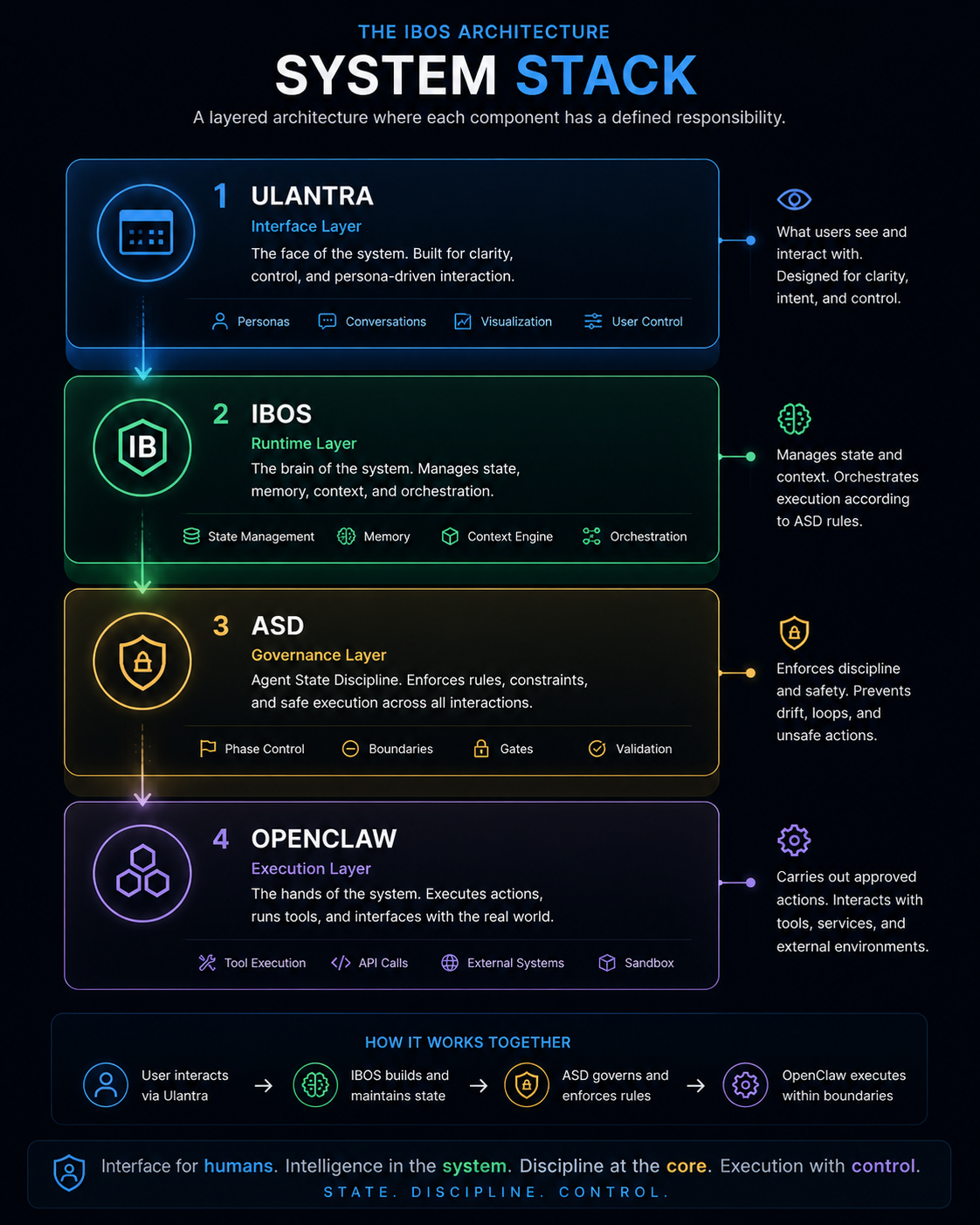
A Runtime for Stateful, Controlled AI Systems
IntelligenceBridgeOS is a runtime control layer that sits between input and output—where behavior is decided before any model generates a response.
Most AI systems treat each interaction as isolated.
IBOS does not.
It tracks signal across multiple dimensions—such as tone, intent, and behavioral drift—and converts that signal into structured system state. That state is carried forward across turns, allowing responses to remain consistent, adaptive, and coherent over time.
Instead of relying on raw prompt history, IBOS distills interaction into a stable, machine-readable control state. This keeps the system readable, bounded, and reliable—even as complexity increases.
How It Works
IBOS operates as a layered runtime where each stage contributes to maintaining and evolving system state:
- Signal Detection – Input is analyzed for meaningful patterns (tone, hesitation, contradiction, continuity).
- State Construction – Signals are converted into a structured control state that represents the system’s current condition.
- Behavior Composition – Policies, persona constraints, and runtime logic are applied to determine response posture.
- Governance & Release – A decision is made to allow, constrain, defer, or block output before generation.
- Provider Execution – Only after governance is satisfied is a model invoked to render the response.
This creates a deterministic control path:
input → state → behavior → governance → generation
Why It Matters
Traditional systems rely on prompts to guide behavior.
IBOS enforces behavior at the system level.
This ensures:
- Persistent behavior instead of reset-per-prompt
- Controlled outputs instead of purely generative responses
- Continuity across sessions without accumulating noise
- Governed execution before any model is called
Behavior doesn’t degrade as conversations grow.
It stabilizes.
Core Architectural Principle
IBOS enforces a mandatory pre-generation runtime.
All outputs must pass through a control kernel that:
- detects meaningful signals in input
- converts them into a structured control state
- evaluates governance rules
- determines whether output is allowed, constrained, deferred, or blocked
Only then is a provider model invoked.
This guarantees that behavior is decided before generation, governance is enforced consistently, and no output bypasses system control.
This pre-generation control model is the core technical distinction of IBOS.
Position in the Stack
IBOS is not a model and not a frontend.
It is the runtime execution authority that governs AI behavior across systems:
- upstream: user input, applications, or agent frameworks
- downstream: model providers (GPT, Claude, etc.)
IBOS determines behavior.
Providers render it.